© OpenStreetMap contributors

There are many ways to discover a region, almost as many as there are ways to understand life. Here we present the Penedès 360 MTB All Mountains route to visit the Penedès through trails, paths, tracks, paved rural roads, and highways that will allow you to see this part of Catalonia from the perspective you love most: from the top of your bike.
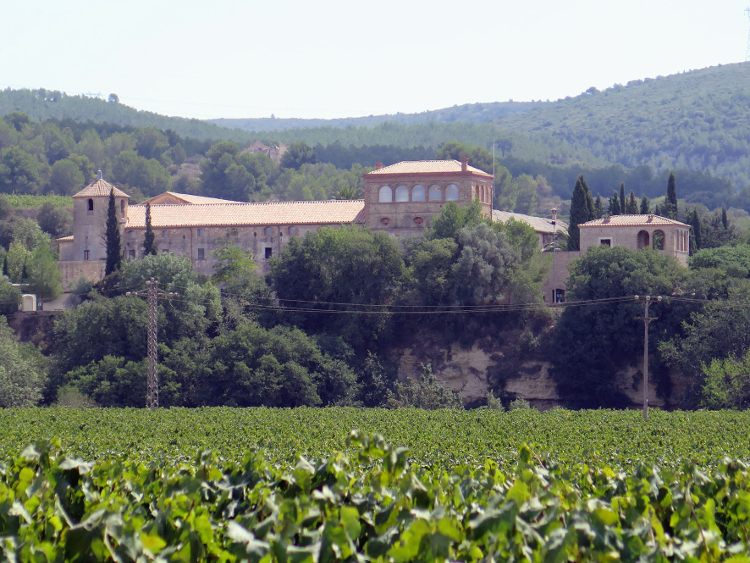
The second stage, which begins in Sant Miquel de Olèrdola and ends in Calafell, passes through Santa Margarida and Els Monjos, skirting Penyafort Castle. It is one of the most emblematic heritage sites in the Alt Penedès region. With almost ten centuries of history, the architectural complex of Penyafort Castle bears witness to the evolution of a territory that, on a local scale, has witnessed some of the most significant events in the history of Catalonia
© OpenStreetMap contributors
The oldest part of this architectonic complex is the circular tower, which probably dates from the 12th century, which corresponds to the remains of the birthplace of Raymond of Penyafort (1185-1275). In addition to this medieval tower, the complex includes various buildings erected as of the 17th century, which were a Dominican convent up until the confiscations of Mendizábal in 1836. Afterwards, the building passed into the hands of the bourgeois Puig i Llagostera family, who made it their summer residence. This building has had several owners over the decades, who have implemented various improvements and projects, until in 2001 it became the property of the municipality.
The Centre for Interpretation of Republican Aviation and Air Warfare is a museum related to aviation and the civil war that is located beside masia del Serral which had housed the republican airfield of els Monjos that was part of the Vesper de la Gloriosa (Hive of the Glorious).
Next to the centre there is the old air raid shelter, whose two entrances and three ventilation chimneys can be seen. The presence of this shelter is related to the existence of the airfield. It is about 10 m deep and has a capacity for about 120 peoples.
The construction known as Foix Mill (formerly Macià mill) is what remains of the old medieval flour mill, which took advantage of the water carried by the Foix river to mill grain. The entire exterior structure of the mill is preserved, as is part of the pool where the water accumulated.
The building, owned by the municipality, is the headquarters of the Foix Mill Historical and Natural Interpretation Centre, Nature Classroom and Botanical Garden, with native species, where educational activities are carried out for school children and the general public on environmental and natural issues.