© OpenStreetMap contributors

Circular routes that take you through various hermitages in the Alt and Baix Penedès, starting the route in Santa Margarida i els Monjos.
Circular routes that take you through various hermitages in the Alt and Baix Penedès, starting the route in Santa Margarida i els Monjos, and passing through the Pujades Castle (Castellví de la Marca), the church of San Marçal (Castellet i la Gornal), the Fountain of Cal Ravella (Castellví de la Marca), the church of Sant Sadurní (Castellví de la Marca), the fountain of Can Ribafort (Castellví de la Marca), the hermitage of Sant Sadurní (Castellví de la Marca), the Torreta (Sant Jaume dels Domenys), the Pi de Llobets (Sant Jaume dels Domenys), the church of Sant Jaume dels Domenys (Sant Jaume dels Domenys), the hermitage of the Mare de Deu dels Arquets (Sant Jaume dels Domenys), the church by Sana Eulàlia (Banyeres del Penedès), the Verge del Priorat hermitage (Banyeres del Penedès), and the Sant Esteve hermitage (Castellet i la Gornal), ending in Santa Margarida i els Monjos.
© OpenStreetMap contributors
The oldest part of this architectonic complex is the circular tower, which probably dates from the 12th century, which corresponds to the remains of the birthplace of Raymond of Penyafort (1185-1275). In addition to this medieval tower, the complex includes various buildings erected as of the 17th century, which were a Dominican convent up until the confiscations of Mendizábal in 1836. Afterwards, the building passed into the hands of the bourgeois Puig i Llagostera family, who made it their summer residence. This building has had several owners over the decades, who have implemented various improvements and projects, until in 2001 it became the property of the municipality.
The Centre for Interpretation of Republican Aviation and Air Warfare is a museum related to aviation and the civil war that is located beside masia del Serral which had housed the republican airfield of els Monjos that was part of the Vesper de la Gloriosa (Hive of the Glorious).
Next to the centre there is the old air raid shelter, whose two entrances and three ventilation chimneys can be seen. The presence of this shelter is related to the existence of the airfield. It is about 10 m deep and has a capacity for about 120 peoples.
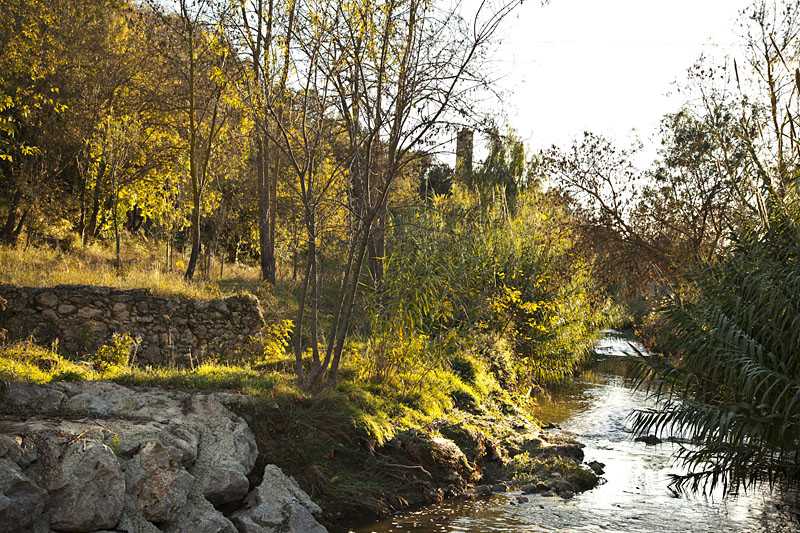
The construction known as Foix Mill (formerly Macià mill) is what remains of the old medieval flour mill, which took advantage of the water carried by the Foix river to mill grain. The entire exterior structure of the mill is preserved, as is part of the pool where the water accumulated.
The building, owned by the municipality, is the headquarters of the Foix Mill Historical and Natural Interpretation Centre, Nature Classroom and Botanical Garden, with native species, where educational activities are carried out for school children and the general public on environmental and natural issues.
A Romanesque chapel situated atop a small hill to the east of the municipality, on the edge of the mountains where the vineyards meet, near the village of Moja. The hermitage of Mare de Déu de Penyafel has been a site of pilgrimages and gatherings, sometimes even organized by neighboring towns. Located near the Penyafel farmhouse and built slightly higher up, both buildings are visible from almost anywhere within the municipality.
The Penyafel chapel is already mentioned in a document from 1131 under the name "Penna Fedel." Inside, the image of the dark-skinned Mare de Déu de Penyafel is venerated, and until the early 20th century, it housed two 15th-century Gothic altarpieces.